
Reviewed · WALKING TOURS
Beautiful Stockholm Small Group Walking Tour
Stockholm’s story unfolds block by block. This 1 hour 45 minute walking tour links royal squares, Parliament, bridges, and the medieval lanes of Gamla stan, giving you a useful first look at the city without taking up your whole day. I like the compact route and the maximum group size of 10, which should make it easier to hear the guide and ask questions.
I also like the way the tour connects architecture with Swedish politics, royal power, the Nobel Prizes, and the country’s long period of peace. The main consideration is the price: at $106.42 per person, this is not a casual stroll for bargain hunters, especially since admission to the listed stops is free and the tour lasts less than two hours. Its value depends on how much you want a guide to explain what you are seeing.
In This Review
- Key things to know before you book
- Starting at Gustav Adolf’s Square with Sweden’s royal story
- Parliament and the long road to equal voting rights
- Riksbron bridge and Stockholm’s postcard views
- Lejonbacken, Karl XII, and the Grand Hotel
- The Royal Palace courtyard and Bernadotte diplomacy
- Stortorget and the darker side of Old Town
- Medieval lanes from Köpmangatan to Skeppsbron
- What the guide adds to the walk
- Is $106.42 good value?
- Who should book this Stockholm walk?
- Final verdict: a useful first look at Stockholm
- FAQ
- Where does the tour begin?
- Where does the tour end?
- How long does the tour last?
- How much does the tour cost?
- How large is the group?
- What language is offered?
- Is the tour suitable for someone with limited fitness?
- Are the stops included with admission?
- Can you reach Djurgården after the tour?
- What is the cancellation policy?
Key things to know before you book
- A royal and political route: You move from the Royal Swedish Opera and Palace to Parliament, government buildings, and the House of Nobility.
- A small group of no more than 10: This is a useful size for a walking tour, especially on narrow Old Town lanes.
- Medieval Stockholm comes late: The final part covers Stortorget, Köpmangatan, Österlånggatan, and Skeppsbron.
- Architecture gets real attention: The guide explains styles and uses visual aids, making the buildings easier to understand.
- A practical museum connection: The tour ends near a tram route for Djurgården, home to several major museums.
- Weather matters: Much of the experience is outdoors, and a windy day can make the walk feel colder than expected.
Starting at Gustav Adolf’s Square with Sweden’s royal story
The tour begins at Gustav Adolfs torg, beside the Royal Swedish Opera. This is a strong starting point because Stockholm’s central buildings quickly introduce the themes that shape the entire walk: monarchy, government, culture, and national identity.
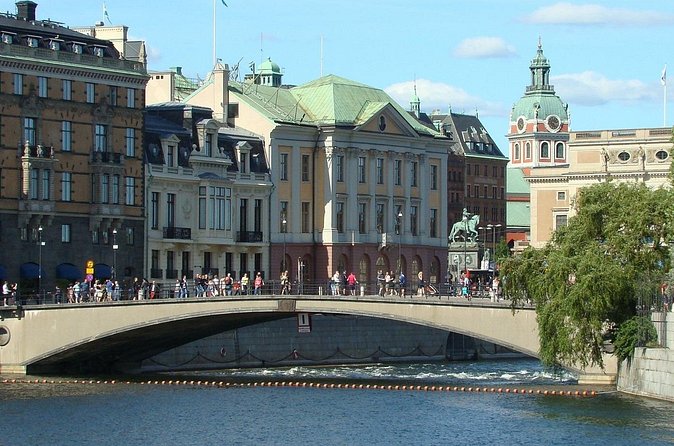
You receive a short introduction to Sweden and Stockholm before setting off. The country’s formal name is the Kingdom of Sweden, and that royal connection is visible almost immediately. Across the area, you can see the Royal Palace, the Opera, and the building that now houses the Ministry of Foreign Affairs.
The Royal Swedish Opera also brings a little drama to the opening. Its connection with Giuseppe Verdi’s opera The Masked Ball links the building to the story of King Gustav III. That is the kind of detail that turns a grand facade into part of a larger tale.
The former Heir Presumptive Palace, now used by the Ministry of Foreign Affairs, adds another layer. You are not simply looking at attractive buildings. You are seeing how royal residences, state offices, and cultural institutions share the same central stage.
This first stop lasts about 15 minutes. Since there is no admission charge, the value here comes from the guide’s explanation and the setting. If you enjoy architecture, ask about the styles and the royal connections while the group is still small.
More Walking Tours in Stockholm
- Stockholm: Ghost Walk and Historical Tour
★ 4.7 · 2,206 reviews - Walking Tour of Stockholm Old Town
★ 5.0 · 1,175 reviews - The Original Stockholm Ghost Walk and Historical Tour – Gamla Stan
★ 4.5 · 1,165 reviews
Parliament and the long road to equal voting rights
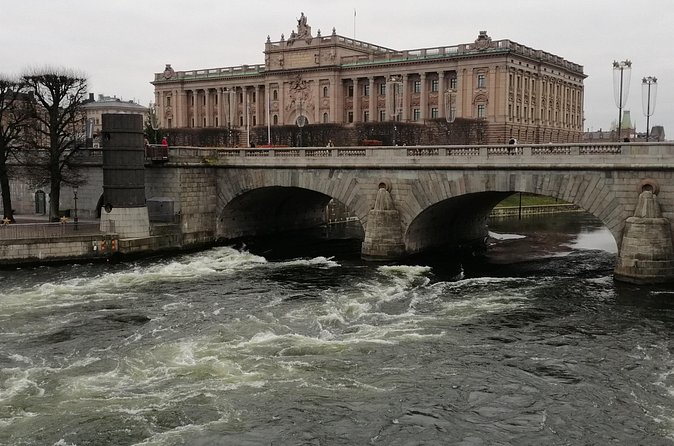
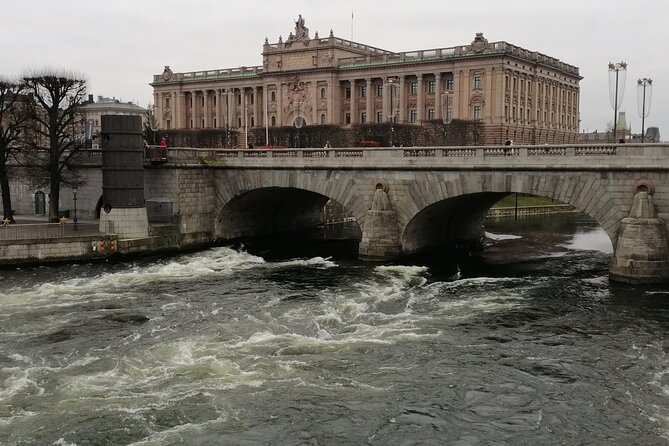
From the Opera, the route moves to Riksdagshuset, the Swedish Parliament Building. It was built between 1897 and 1905 in Neo-Renaissance style, with a Neo-Baroque section on the facade. The building gives the tour a clear shift from royal power to modern government.
The political story is especially useful for understanding Sweden today. Before the current parliament, the Riksdag of the Estates brought together nobles, clergy, burghers, and peasants. These groups met separately before meeting the king, and the institution remained the highest authority in Sweden next to the monarch until 1866.
That system changed, but equal voting rights did not arrive at once. A two-chamber parliament came in 1866, though citizens still did not have equal voting rights. General suffrage followed in 1921 after a long campaign led by liberals and socialists.
In 1975, the two chambers merged into one. The constitution also confirmed that the king would have a representative role rather than real political power. I like this stop because it gives context to the palace views you have just seen. Sweden’s present system makes more sense when you understand the gradual move from estates and monarchy toward representative democracy.
The Parliament stop is about 10 minutes. That is enough for an introduction, but not a full political history lesson. You will get the main timeline and the building’s role, then continue before the details become too dense.
Riksbron bridge and Stockholm’s postcard views
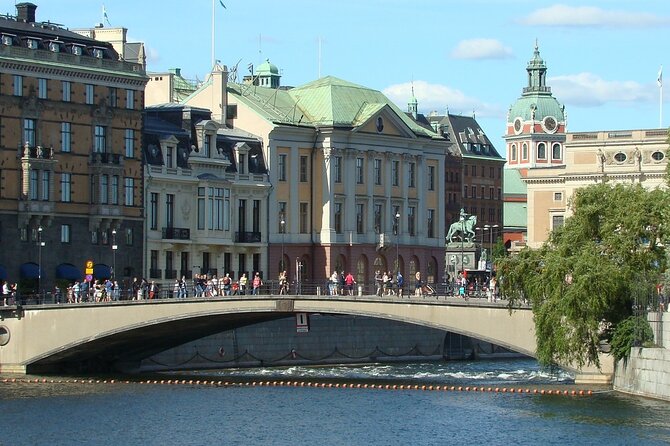
Riksbron offers one of the tour’s best visual pauses. From the bridge, you can look toward Riddarholmen, known in English as Knights Island, as well as the Prime Minister’s residence, government buildings, and the House of Nobility.
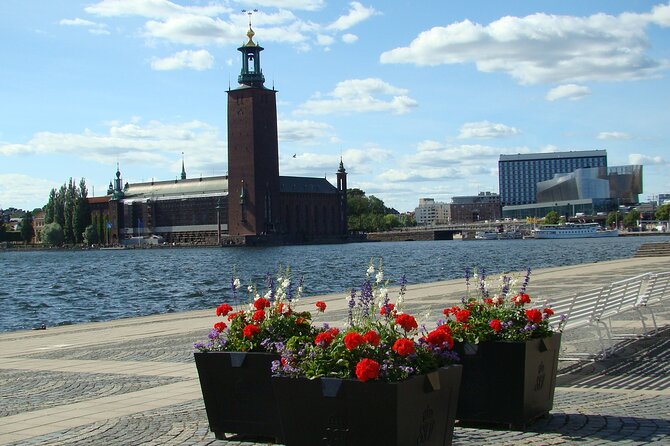
You can also see Stockholm City Hall, where the Nobel Prize banquet takes place each year. The view helps connect several parts of Swedish public life at once: government, aristocratic history, national ceremony, and the Nobel tradition.
This is a good place to have your camera ready, but do not let the photo stop become the whole point. The guide’s job here is to identify the buildings and explain why they matter. The bridge gives you a useful map of central Stockholm, which can help later when you explore on your own.
The stop lasts around 15 minutes. Since the tour is outdoors, this is also where weather can affect your comfort. A windy day has already been noted as a drawback, and bridges offer little shelter. Bring a layer even if the forecast looks mild.
Lejonbacken, Karl XII, and the Grand Hotel
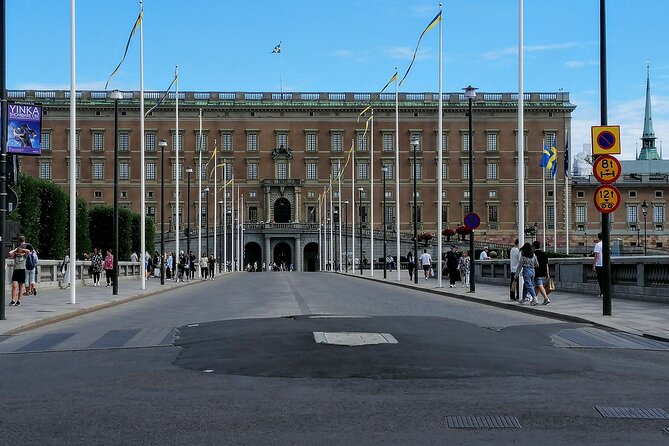
Lejonbacken lies on the north side of the Royal Palace and is one of Stockholm’s most popular photo spots. The setting gives you a broad view toward the palace approach and nearby city buildings.
Here, the guide places Stockholm in the context of Sweden’s period as a great power in Northern Europe during the 17th and 18th centuries. You see the Royal Garden and a statue of Karl XII, remembered as the last of the Swedish warrior kings.
The stop also looks beyond the monarchy. To the right of the park is Stockholm’s Financial District, much of it built around the turn of the 20th century. That period brought a flowering of architectural styles, so this part of the route is useful if you enjoy comparing older royal buildings with later commercial architecture.
The Grand Hotel is another landmark in view. It is Stockholm’s most prestigious hotel and the place where Nobel laureates stay during the Nobel Prize ceremonies. That detail gives the waterfront and central city a modern ceremonial link.
This stop takes about 15 minutes. It is one of the stronger sections for photos, but it may feel more like an outdoor orientation than a close look at interiors. You will see important places from public streets rather than touring every building.
More walks:
- Stockholm: Old Town Walking Tour with Local Guide
★ 4.7 · 719 reviews - Best of Stockholm Walking Tour-3 Hours, Small Group max 10 people
★ 5.0 · 645 reviews - The Nordic Food Walk Stockholm
★ 4.5 · 642 reviews - Walking Tour of Stockholm’s Old Town, Gamla Stan
★ 5.0 · 451 reviews
The Royal Palace courtyard and Bernadotte diplomacy
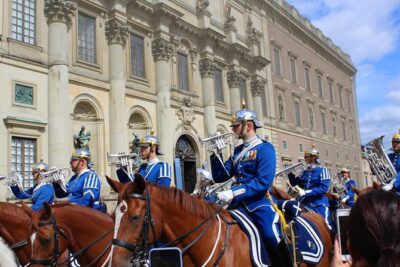
At Slottsbacken, the route passes through the inner courtyard of the Royal Palace. You also make a short visit to the Palace Chapel, where the royal family baptizes its children.
The chapel visit is brief, so you should not expect a full palace tour. Still, it adds an interior moment to a route that is otherwise mainly outside. It also shows how the palace remains tied to family ceremonies, not just state occasions.
Outside, you see the statue of Carl XIV Johan, the founder of the Bernadotte dynasty. His path to the Swedish throne was unusual. He began as a soldier in Napoleon’s army and was later adopted into the Swedish royal family.
The story becomes more interesting because he was brought to Sweden to help recover territory lost to Russia during the Napoleonic wars. Instead of pursuing another round of war, he focused on diplomacy, infrastructure, and education. Sweden celebrated 200 years of peace in 2014.
That shift from military ambition to practical nation-building is one of the tour’s more memorable ideas. Industrial development, natural resources, and Swedish inventions later helped create the foundation for the welfare state.
This stop lasts about 10 minutes. It is short, but the story is worth remembering because it explains why Swedish identity often includes both royal tradition and a strong focus on public institutions.
Stortorget and the darker side of Old Town
The route then reaches Stortorget, the central square of Gamla stan and one of the most photographed places in Stockholm. The square is surrounded by colorful historic buildings in 17th-century Scandinavian Renaissance and 18th-century Classical styles.
This is the point where the city can look almost storybook-like, but the history is far from gentle. In November 1530, the Stockholm Bloodbath took place here. Around 100 noblemen and priests were beheaded by the Danish king Christian II, who became known in Sweden as Christian the Tyrant.
The contrast is striking. You stand among carefully preserved facades while hearing about political violence that shaped Swedish memory. I appreciate that the walk does not treat Old Town as decoration only. The square has beauty, but it also carries the marks of power struggles between Sweden and Denmark.
Stortorget is also home to the Nobel Prize Museum. The Swedish Royal Academies and other committees select the winners of the prizes, which cover important fields of science and art. The museum provides a possible follow-up visit if the Nobel story catches your interest.
The stop is planned for about 15 minutes. It can be a busy area, and the square is a popular photo point, so staying close to the guide matters. The short visit gives you the essential story and location, but not time for a full museum visit.
Medieval lanes from Köpmangatan to Skeppsbron
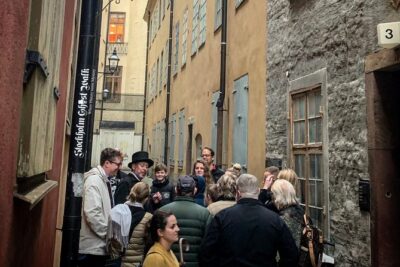
The final part is the most atmospheric. From Stortorget, you walk along Köpmangatan, or Merchants Street, which has appeared in written records since 1350. The route then uses narrow alleyways that give you a feel for medieval Stockholm.
This is where the tour shifts from grand public buildings to the texture of daily urban life. Tight lanes, old facades, and changes in street width help you picture how the medieval town developed within limited space.
You continue along Österlånggatan and descend toward Skeppsbron. Ships have loaded cargo here since the 17th century, so the waterfront provides a useful link between the old merchant city and Stockholm’s later trade.
The Old Town section lasts about 20 minutes, the longest single stop. It is also the part where the small group matters most. Ten people or fewer should be easier to manage in narrow passageways than a large tour group, and a friendly, personable guide can keep the history moving without turning the walk into a lecture.
The tour ends at the southern end of Kungsträdgården, near the statue of Karl XII. This is a practical finish. You can continue into the park, find transport, or take the tram to Djurgården, the island of museums. The Vasa Museum, Viking Museum, ABBA Museum, and open-air Skansen are all located there.
What the guide adds to the walk
The quality of a short historical walk depends heavily on the guide. Here, the guide is described as friendly and personable, with an informative approach that helps the history stay approachable.
A particularly useful feature is the use of visual aids when explaining architecture. Stockholm has many historic buildings, but architectural labels can blur together if you only hear them spoken. Seeing examples while looking at Neo-Renaissance, Neo-Baroque, Classical, and Scandinavian Renaissance buildings can make the differences easier to follow.
The tour also handles the Viking era with some restraint. You may hear it mentioned as part of Sweden’s wider past, but the main focus is Stockholm’s medieval, royal, political, and architectural story. If you want a dedicated Viking tour, this is not that experience. If you want a broad introduction to central Stockholm, the balance makes sense.
Is $106.42 good value?
At $106.42 per person, the tour sits at the expensive end for a 1 hour 45 minute walk. The listed stops do not require admission fees, so you are paying for the guide, route planning, small-group setting, interpretation, and convenience.
The maximum of 10 people improves the value. You are not paying for a large procession that stops only long enough for everyone to catch up. You should have a better chance to hear the explanations and ask about buildings that interest you.
Still, I would compare this price with your own plans. If you are comfortable reading about Stockholm and walking independently, you can visit the squares and streets without paying an admission fee. If you have limited time, are arriving on a cruise, or want a clear story instead of disconnected sights, the guided route can save you effort.
The average booking time is 11 days in advance, so booking earlier is sensible if your dates are fixed. Free cancellation is available until 24 hours before the start time, which gives you some flexibility.
Who should book this Stockholm walk?
I would recommend it to first-time visitors who want a quick orientation before visiting museums or exploring independently. It suits people who like royal history, government, architecture, and city stories more than a single narrow subject.
It is also a good fit for cruise passengers with a limited window in central Stockholm. The route ends near Kungsträdgården and transport toward Djurgården, so you can continue to the Vasa Museum, Viking Museum, ABBA Museum, or Skansen afterward.
You should be comfortable walking for nearly two hours and dealing with outdoor conditions. The tour asks for moderate physical fitness, and wind can make the route less pleasant. Wear sensible shoes and bring a warm layer, particularly if your visit falls during changeable weather.
I would not choose it if you mainly want to enter museums or spend a long time inside the Royal Palace. The tour is primarily an outdoor sightseeing and history walk, with only a short chapel visit.
Final verdict: a useful first look at Stockholm
Book this tour if you value a small group, a friendly guide, and a clear route through Stockholm’s royal and medieval center. The strongest parts are the political context at Parliament, the views from Riksbron, the architectural explanations, and the final walk through Gamla stan.
Skip it if $106.42 feels too high for a short walk or if you prefer exploring historic streets at your own pace. For everyone else, it offers a tidy introduction that ends in a useful place for continuing your day, especially toward Djurgården’s museums.
FAQ
Where does the tour begin?
The tour begins at Gustav Adolfs torg, 111 52 Stockholm, Sweden.
Where does the tour end?
It ends at the southern end of Kungsträdgården, near the statue of Karl XII at Karl XII:s torg 9.
How long does the tour last?
The tour lasts approximately 1 hour and 45 minutes.
How much does the tour cost?
The listed price is $106.42 per person.
How large is the group?
The tour has a maximum of 10 travelers.
What language is offered?
The tour is offered in English.
Is the tour suitable for someone with limited fitness?
Participants should have a moderate level of physical fitness.
Are the stops included with admission?
The listed stops show free admission. The tour includes a short visit to the Palace Chapel, but it does not list admission to the Nobel Prize Museum, Royal Palace interiors, or other museums.
Can you reach Djurgården after the tour?
Yes. The tour ends near Kungsträdgården, where it is possible to take the tram to Djurgården.
What is the cancellation policy?
You can cancel up to 24 hours before the experience starts for a full refund. Cancellations or changes made less than 24 hours before the start time are not accepted for a refund.
Recently added around Stockholm
- ROYAL Castle Skokloster and Viking Sigtuna (private tour)★ 4.5 · 3 reviews
- Stockholm Ghost Hunt: Self-Guided Tour and Puzzle Adventure★ 4.5 · 3 reviews
- Stockholm Port to Stockholm Arlanda Airport (ARN) – Departure Private Transfer★ 3.5 · 3 reviews
- Private Photography workshop in Stockholm★ 5.0 · 3 reviews
- Ghosts of Stockholm: A Guided Tour of Horror and Dark Folklore★ 4.5 · 3 reviews
- Private blood, ghosts and folklore Old Town 2h Stockholm tour★ 4.0 · 3 reviews
- Stockholm- Private transfer to/from Arlanda Airport and city★ 5.0 · 3 reviews
- Stockholm Arlanda airport to City center of Stockholm★ 3.3 · 3 reviews
Walking Tours, compared.
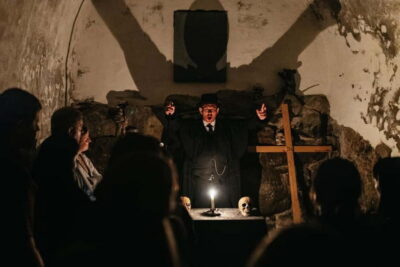
The Original Stockholm Ghost Walk and Historical Tour – Gamla Stan
Read our review →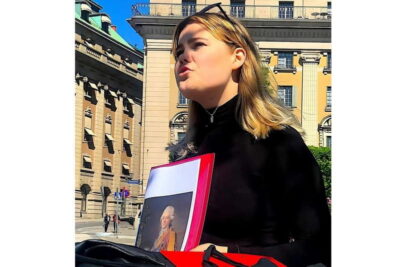
Best of Stockholm Walking Tour-3 Hours, Small Group max 10 people
Read our review →

Walking Tour of Stockholm’s Old Town, Gamla Stan
Read our review →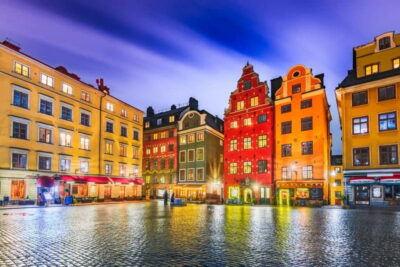
Browse the lists this tour appears in