
Reviewed · WALKING TOURS
The Story of Stockholm and Sweden in Three Chapters, a Small Group Walking Tour
Stockholm makes history easy to follow. This two-hour walk links Sweden’s past to its present, from Birger Jarl and Gustav Vasa to Spotify, IKEA, and the modern welfare state. I like the clear three-chapter format, and I like the small group capped at 10 people, which leaves room for questions instead of crowding around a guide.
The route also includes the open parts around the Royal Palace and ends near Stortorget, with the changing of the guards often close at hand. The main drawback is its pace: ten stops in about two hours means the tour gives you a strong outline, not a long look inside every landmark.
In This Review
- Key points to know before you go
- Why the three-chapter format works
- Chapter One: Stockholm begins on the islands
- Chapter Two: Gustav Vasa and the making of Sweden
- Parliament and the long road to equal voting rights
- Chapter Three begins at the Royal Palace
- Carl XIV Johan and two centuries of peace
- Ending at Stortorget and the Nobel Prize Museum
- Group size, walking effort, and timing
- Who will get the most from this walk?
- Is $61.28 a fair price?
- Should you book it?
- FAQ
- How long is the Stockholm history walking tour?
- What time does the tour start?
- Where does the tour begin?
- Where does the tour end?
- What language is the tour offered in?
- How many people can join the tour?
- Is admission included?
- How physically demanding is the walk?
- Can I cancel for a full refund?
Key points to know before you go
- Three chapters make Swedish history easy to follow: Early Stockholm, the age of kings, and the road to modern Sweden are presented as one connected story.
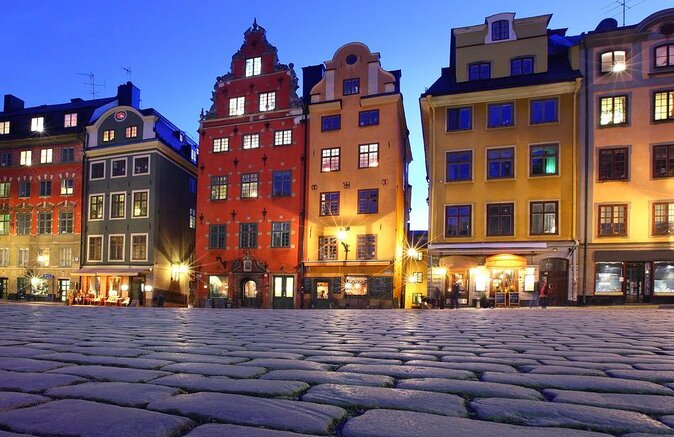
- The route covers Riddarholmen, Riddarhuset, Parliament, the Royal Palace, and Stortorget: You see major political and royal sites without zigzagging across the city.
- The group is limited to 10 people: That is a useful size for hearing the guide and asking questions.
- The walk begins at 10:00 a.m. and lasts about two hours: Plan your morning around a steady route through central Stockholm.
- The tour costs $61.28 per person: For a small-group history walk, the value depends on how much you want context rather than long interior visits.
- The route finishes near the changing of the guards: In summer, you may be timed for the parade and music corps at the Royal Palace.
Why the three-chapter format works
Stockholm can feel like a collection of handsome buildings until someone explains how the pieces fit. This walk gives you a simple framework: the first chapter covers the origins of Stockholm and Sweden, the second focuses on Gustav Vasa and the Swedish state, and the third follows the country from imperial decline to modern prosperity.
I find that structure helpful because Sweden’s past includes several kings with similar names, shifting borders, religious change, and a complicated move toward democracy. The chapter system gives you a mental map. You are not just hearing isolated facts about statues and palaces. You are following a country as it forms, fights, reforms, and changes its priorities.
The experience is conducted in English and uses a mobile ticket. It is designed for a moderate level of physical fitness, so you should expect a walking route through the old city rather than a vehicle-based sightseeing trip. Public transportation is nearby, making the start practical if you are staying outside Gamla Stan.
At $61.28, this is not the cheapest way to stroll through Stockholm. You can walk past most of these places on your own for free. The value comes from having the political and historical links explained in real time, plus the comfort of a group no larger than 10 people.
More Walking Tours in Stockholm
- Stockholm: Ghost Walk and Historical Tour
★ 4.7 · 2,206 reviews - Walking Tour of Stockholm Old Town
★ 5.0 · 1,175 reviews - The Original Stockholm Ghost Walk and Historical Tour – Gamla Stan
★ 4.5 · 1,165 reviews
Chapter One: Stockholm begins on the islands
The tour opens at the Gamla Stan Metro station area, with the directions identifying the spot inside or below ground near the Pressbyrån kiosk. The formal starting address is Munkbrogatan 8, so I would check the exact meeting instructions before setting out. That small bit of preparation matters in Gamla Stan, where narrow lanes and several nearby squares can make a simple address less obvious than it looks.
The first stop is a historical marker on Riddarholmen. Here, the guide sets the scene from the ice age through the first settlements on the islands. That is a useful beginning because Stockholm is not just an old town with pretty facades. Its location across islands shaped how people moved, traded, defended the settlement, and later built a capital.
You spend about 15 minutes in this opening section. You also walk around and visit the open parts of the palace area, with no separate admission charge along the route. Do not expect a long museum visit here. The point is orientation, and the short stop helps you understand why this particular group of islands became important.
The next stop is outside Riddarholmen Church, where a statue represents Birger Jarl, the figure traditionally linked with Stockholm’s founding. The year 1252 is central to this part of the story because it is the first known written mention of Stockholm preserved today.
That detail gives the city a firm historical marker, but the guide also helps you avoid a common trap. A founding date does not mean the city appeared fully formed in that year. Stockholm developed over time, and this stop introduces the people and documents connected with that early period.
Riddarholmen Church itself is a strong visual stop, but the tour focuses on the exterior and the story around it. If you want extensive church interiors or detailed architectural study, you will need to make separate time later.
Chapter Two: Gustav Vasa and the making of Sweden
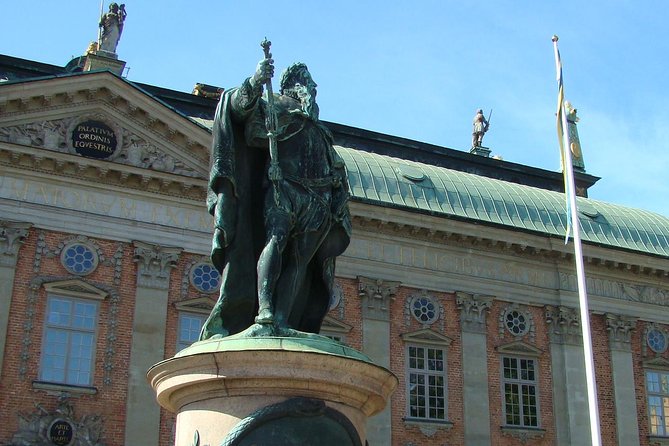
At Riddarhuset, the House of Nobility, the subject shifts from the origins of the city to the creation of the Swedish state. The statue of Gustav Vasa provides the focus.
Gustav Vasa is presented as the father of Sweden, a title tied to his role in the country’s break from Danish control. After the Stockholm Bloodbath, in which his father and many other nobles were killed, Gustav led an uprising against the southern neighbor that had taken control of Sweden. In 1523, he entered Stockholm and became king.
This is one of the most useful stops for understanding why Swedish national history places so much weight on Gustav Vasa. He did not simply inherit a stable kingdom. He helped establish Sweden as a sovereign state, and his reign also brought a major religious change, moving the country from Catholicism to Lutheran Protestantism.
The tour spends roughly 10 minutes here. That is enough for the main story, but not enough for every detail of the Reformation, the political struggle, or Gustav’s rule. Think of this as a clear introduction you can build on if you later visit museums or historical sites.
At Vasabron, the story turns to Gustav Vasa’s heirs and heiresses. His grandson, Gustav II Adolf, became Sweden’s most famous warrior king. During his reign, Swedish possessions spread around the Baltic Sea until it functioned almost like an inland sea surrounded by Swedish-held territory.
This stop is valuable because it shows how ambitious Sweden once was. Modern Sweden is widely associated with neutrality, diplomacy, social policy, and design. The seventeenth-century kingdom was a military power seeking influence around the Baltic.
You get a quick look at succession, royal ambition, and the cost of expansion. The stop lasts about 10 minutes, so the treatment is broad rather than personal. If royal family trees make your eyes glaze over, the guide’s larger point should still land: Sweden’s identity was shaped by both national independence and aggressive regional power.
Parliament and the long road to equal voting rights
The Parliament Building, or Riksdagshuset, provides one of the tour’s strongest links between royal Sweden and modern democracy. Before the present parliamentary system, the Riksdag of the Estates brought together four groups: Nobility, Clergy, Burghers, and Peasants.
These groups met separately before meeting the king at the palace. Until the system ended in 1866, the Riksdag of the Estates was the highest authority in Sweden next to the monarch. A two-chamber parliament followed, but voting rights were still not equal for all citizens.
General suffrage came only after a long political struggle led by liberals and socialists, with the first elections under that system held in 1921. That date is worth remembering. Sweden’s modern democratic reputation did not appear overnight, and the route makes that development part of the same story as kings, battles, and palaces.
The Parliament stop lasts about 10 minutes. The building is mainly a visual anchor for the explanation, not a parliamentary tour. You will not be entering for a session or receiving a full lesson in current Swedish politics based on the information provided.
Still, I like this pause in the route. It keeps the walk from becoming a parade of royal names. You see how power moved from monarchs and social estates toward representative government, which makes the final chapter about industry and social welfare easier to understand.
More walks:
- Stockholm: Old Town Walking Tour with Local Guide
★ 4.7 · 719 reviews - Best of Stockholm Walking Tour-3 Hours, Small Group max 10 people
★ 5.0 · 645 reviews - The Nordic Food Walk Stockholm
★ 4.5 · 642 reviews - Walking Tour of Stockholm’s Old Town, Gamla Stan
★ 5.0 · 451 reviews
Chapter Three begins at the Royal Palace
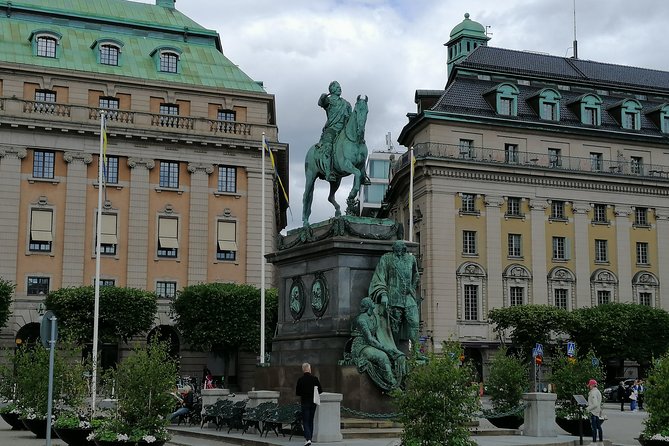
The third chapter starts at Lejonbacken, on the north side of the Royal Palace. Here the story turns to Sweden’s decline as a great power and its later shift toward peace, education, science, and industry.
A statue of Karl XII points east, toward the direction of his campaigns and the armies of Peter the Great of Russia. Karl XII and the Caroleans won early victories, but Sweden’s great-power ambitions ended after defeat at Poltava in 1709.
This is a concise explanation of a major turning point. Sweden did not simply lose one battle and change overnight. The defeat helped end the era when the country could dominate the Baltic region. The walk uses the palace setting and the statue’s direction to make that shift easy to picture.
The next part introduces the Enlightenment, when interest in science, art, and ideas grew across Europe. Gustav III is described as an enlightened despot with a strong interest in theatre and the arts. His role adds another shade to the royal story: a king could support cultural and scientific progress while still ruling with heavy personal authority.
You spend about 10 minutes at this palace stop. The open areas provide atmosphere, but the experience is not a full Royal Palace interior tour. That distinction matters if rooms, furnishings, and royal collections are high on your list.
Carl XIV Johan and two centuries of peace
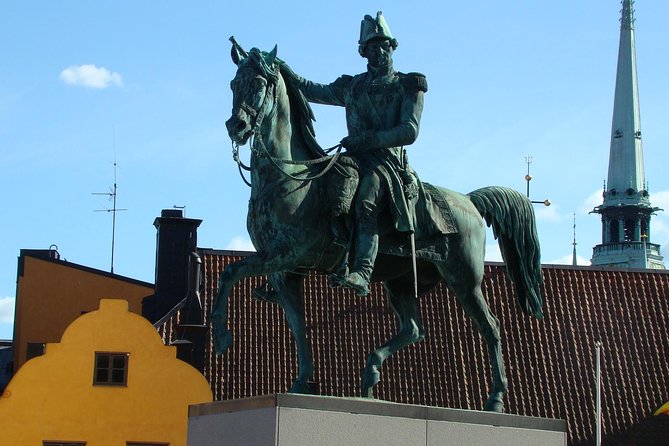
Below the statue of Carl XIV Johan, the guide continues with the first Bernadotte king. He was brought to Sweden from France in the early nineteenth century in the hope that he could help recover territory lost to Russia.
Instead of launching another round of major wars, Carl XIV Johan focused on diplomacy, infrastructure, and education. That choice helps explain the direction Sweden took after the fall of its great-power ambitions. The country’s later reputation for stability did not come from having no difficult past. It came partly from changing course.
In 2014, Sweden celebrated 200 years of peace. The route connects that long period without war to the industrial revolution, Sweden’s natural resources, Swedish inventions, and the growth of a welfare state.
The guide also brings the story into the twentieth and twenty-first centuries by referring to entrepreneurs and well-known Swedish companies. You learn about the origins of Spotify and IKEA, a practical touch that helps connect Stockholm’s older streets with the country you recognize today.
This final historical section lasts about 20 minutes, making it the longest stop. That extra time is sensible because modern Sweden cannot be explained by kings alone. Industry, education, resources, invention, and business all play a role.
Ending at Stortorget and the Nobel Prize Museum
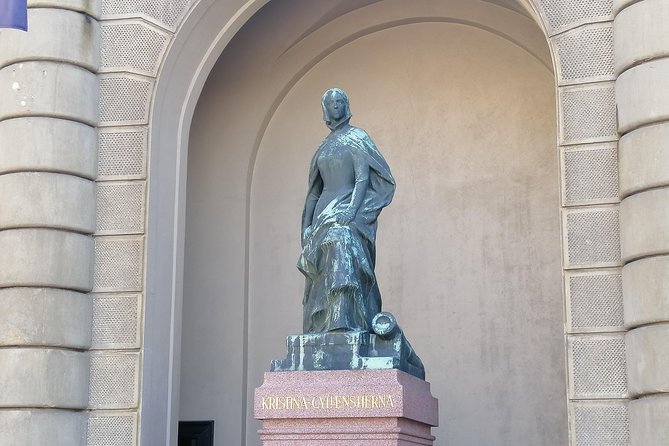
The walk finishes at Stortorget, the main square in Stockholm’s Old Town. The Nobel Prize Museum is located here, and the guide explains the Swedish Royal Academies’ role in selecting winners in important areas of science and art.
Stortorget is a natural end point. It places you in one of the most recognizable parts of Gamla Stan, close to the Royal Palace and surrounded by historic buildings. The tour ends at a spot where you can continue sightseeing without needing another transfer.
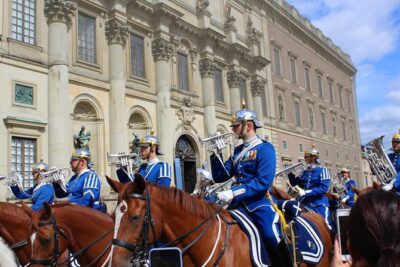
There is also a timing bonus. The tour is scheduled to finish close to the Royal Palace, often in time to see the changing of the guards. The parade is especially popular in summer, when the Music Corps may march or ride through to the palace’s Outer Courtyard.
The timing is useful, but it should not be treated as a guaranteed centerpiece of the tour. The changing of the guards can depend on the day and season, and the tour information specifically highlights the summer parade. You may want to confirm the schedule separately if seeing it is important to you.
Group size, walking effort, and timing
A two-hour walk sounds easy, but Gamla Stan has uneven streets, turns, and a steady sequence of stops. The activity calls for moderate physical fitness. I would wear comfortable shoes and avoid carrying more than you need.
The small-group limit of 10 is one of the strongest practical features. A guide can usually speak to a group this size without shouting, and you have a better chance of asking about a point that interests you. It also makes the route feel less like a procession.
The 10:00 a.m. start works well for building the rest of your day around the Old Town. You finish near Stortorget, so you can continue to the Nobel Prize Museum, explore the palace area, or remain in Gamla Stan for more walking.
The route is offered in English. Since the stops are short, listen closely at each one. If you arrive late, catching up may be awkward because the group moves from one site to the next rather than waiting in one place for a long talk.
Who will get the most from this walk?
I would choose this tour if you want a guided introduction to Stockholm before exploring on your own. It suits first-time visitors who want to understand why the palace, Parliament, Riddarholmen, and Old Town matter rather than simply photograph them.
It is also a good fit if you enjoy political and royal history, especially the transition from medieval settlement to sovereign state, military power, constitutional government, and modern industry. The references to IKEA and Spotify give the final section a familiar hook.
Families with older children may appreciate the short chapters and frequent changes of scene. The walk is also useful for anyone with only a morning in Stockholm because it covers several central landmarks without requiring a full-day commitment.
I would be more cautious if you want long interior visits, detailed architecture, or a leisurely pace. The tour spends around 10 minutes at many stops, and the palace visit is limited to open areas described along the route. Independent explorers who already know Swedish history may find the overview too brief.
One published experience described a shorter version taken because of a tight schedule, with the participant wishing there had been time for the full tour and saying they would take it again. That is a helpful clue about the format: the walk is educational enough to make you want more, but you should protect the full two hours if history is your main reason for booking.
Is $61.28 a fair price?
At $61.28 per person, you are paying about $30.64 for each hour of a small-group guided walk. Since the major outdoor stops do not require separate admission, the price is not mainly buying entrance tickets.
You are paying for the guide’s selection and explanation of the route, the English-language presentation, and a group capped at 10. If you would otherwise wander past these buildings without knowing the connections, that added context can make the fee worthwhile.
The value is weaker if you prefer free self-guided walks or want your money to cover substantial indoor admissions. The tour is best judged as a compact history lesson with a carefully arranged route, not as a package of museum tickets.
Free cancellation is available if you cancel at least 24 hours before the 10:00 a.m. start. Changes or cancellations made inside that window are not accepted for a refund.
Should you book it?
Book this walk if you want Stockholm’s major historical themes explained in plain order, from the first settlements and Birger Jarl to Gustav Vasa, Parliament, the fall of Swedish power, and the rise of companies such as IKEA and Spotify.
Skip it if you mainly want palace interiors, long museum visits, or a slow photography walk. For most first visits, though, the 10-person limit and three-chapter story make this a useful first morning in Stockholm, especially if you like leaving a city with a better sense of how it became what it is.
FAQ
How long is the Stockholm history walking tour?
The tour lasts approximately two hours.
What time does the tour start?
The stated start time is 10:00 a.m.
Where does the tour begin?
The meeting information gives Munkbrogatan 8, 111 27 Stockholm, Sweden. The directions also identify the Gamla Stan Metro station area, inside or underground near the Pressbyrån kiosk.
Where does the tour end?
The tour ends at Stortorget, 111 29 Stockholm, Sweden, near the Royal Palace and the Nobel Prize Museum.
What language is the tour offered in?
The tour is offered in English.
How many people can join the tour?
The group has a maximum of 10 people.
Is admission included?
Admission is included along the route where applicable. The listed stops are marked as having free admission, and the palace portion refers to walking around and visiting open areas.
How physically demanding is the walk?
A moderate level of physical fitness is recommended. You should expect to walk between several central Stockholm sights during the two-hour route.
Can I cancel for a full refund?
Yes. You can cancel at least 24 hours before the experience start time for a full refund. Cancellations or changes made less than 24 hours before the start are not refunded or accepted.
Recently added around Stockholm
- ROYAL Castle Skokloster and Viking Sigtuna (private tour)★ 4.5 · 3 reviews
- Stockholm Port to Stockholm Arlanda Airport (ARN) – Departure Private Transfer★ 3.5 · 3 reviews
- Stockholm Ghost Hunt: Self-Guided Tour and Puzzle Adventure★ 4.5 · 3 reviews
- Private Photography workshop in Stockholm★ 5.0 · 3 reviews
- Ghosts of Stockholm: A Guided Tour of Horror and Dark Folklore★ 4.5 · 3 reviews
- Private blood, ghosts and folklore Old Town 2h Stockholm tour★ 4.0 · 3 reviews
- Stockholm- Private transfer to/from Arlanda Airport and city★ 5.0 · 3 reviews
- Stockholm Arlanda airport to City center of Stockholm★ 3.3 · 3 reviews
Walking Tours, compared.
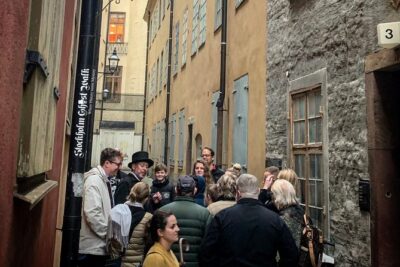
The Original Stockholm Ghost Walk and Historical Tour – Gamla Stan
Read our review →
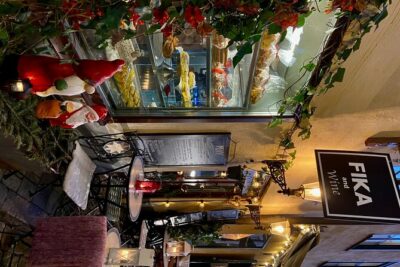
Best of Stockholm Walking Tour-3 Hours, Small Group max 10 people
Read our review →

Walking Tour of Stockholm’s Old Town, Gamla Stan
Read our review →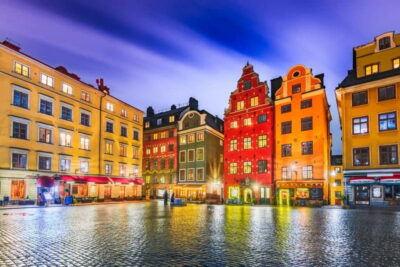
Browse the lists this tour appears in