
Reviewed · STOCKHOLM TOURS
Stockholm Must Sees
Stockholm’s best first look fits into three hours. This tour pairs Gamla Stan’s medieval lanes with the remarkable Vasa Museum, giving you a useful introduction to the city without spending half a day arranging tickets and transport. I especially like the public ferry ride to Djurgården and the included museum admission. The main drawback is the pace: the Old Town portion covers many sights quickly, so it may feel like a fast pass by if you want long visits inside each one.
The tour costs $113.48 per person and usually fills about 37 days ahead. That price is reasonable if you value a guide who can explain the stories behind ordinary streets and help you make sense of the Vasa Museum. Just bring comfortable shoes, since much of the walk is over uneven cobblestones and the tour runs in all weather.
In This Review
- Key points to know before booking
- Why this tour works as a Stockholm introduction
- Meeting at Stockholm’s oldest square, Stortorget
- Prästgatan and the darker side of medieval Stockholm
- The Royal Palace from the outside
- Storkyrkan and Stockholm’s royal weddings
- Järnpojke, Stockholm’s tiny statue
- St. George, the dragon, and a medieval political story
- Squeezing through Mårten Trotzigs gränd
- The public ferry from Skeppsbron to Djurgården
- The Vasa Museum and the ship that sank on its first voyage
- Guide quality and group size
- Price, pace, and who gets the best value
- Should you book Stockholm Must Sees?
- FAQ
- How long does the Stockholm Must Sees tour last?
- What time does the tour begin?
- Where does the tour start?
- Where does the tour finish?
- Is Vasa Museum admission included?
- Is the ferry ticket included?
- How large is the tour group?
- Can I cancel for a full refund?
Key points to know before booking
- Two major sights in one morning: Walk through Gamla Stan, then take a public ferry to the Vasa Museum.
- A strong first-day choice: The route helps you get your bearings and points out places you may want to revisit.
- The Vasa ticket is included: You enter with the group rather than arranging admission separately.
- The ferry is part of the sightseeing: This is public transport, but it also gives you a pleasant water-level view of central Stockholm.
- The tour ends at the Vasa Museum: You can stay and continue exploring, or make your own way back by foot or public transport.
- Guide quality matters: Kevin, Katrine, Ebba, Joel, and Marita have all been praised for clear explanations, warmth, and good pacing, though one poor experience involved a guide who could not be heard.
Why this tour works as a Stockholm introduction

Stockholm can feel confusing at first. The city spreads across islands, water crossings, grand public buildings, and small old streets. This tour gives you a simple route through two very different sides of the city: the old center of Gamla Stan and the purpose-built museum world of Djurgården.
I like that the outing is not just a standard walking circuit. You begin on foot, switch to a ferry, and finish with a museum visit. That change of setting keeps the morning moving and shows you how locals use the water as part of the city’s transport system.
The format is also efficient. In roughly three hours, you see the main Old Town sights, ride a ferry, enter one of Stockholm’s most important museums, and hear background information that is easy to miss when you explore alone. It is a good fit for your first morning in town, especially if you want help deciding where to spend more time later.
The tradeoff is depth. The walking section includes many stops, but most last only about 10 to 15 minutes. You will hear the story of each place and take photographs, but you should not expect extended interior visits or a slow architectural study.
A few more ways to spend a day in Stockholm
- Stockholm: City Archipelago Sightseeing Cruise with Guide
★ 4.3 · 10,798 reviews - Stockholm: Skansen Open-Air Museum Admission Ticket
★ 4.5 · 3,427 reviews - Stockholm: Archipelago Boat Tour
★ 4.4 · 3,110 reviews
Meeting at Stockholm’s oldest square, Stortorget
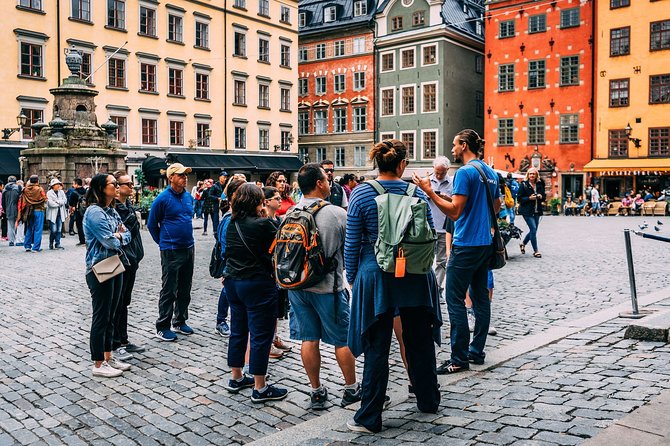
The morning begins at 10:00 am at Stortorget, the central square in Gamla Stan. This is a practical meeting point because it places you in the heart of Stockholm’s Old Town from the first minute.
Stortorget has long been the center of Gamla Stan. Its colorful buildings and cobbled surface make it one of the city’s easiest places to recognize, but the guide adds context beyond the usual photograph. The square is also home to the Nobel Museum, dedicated to Alfred Nobel and the prizes connected with his legacy.
You spend about 15 minutes here. That is enough time to hear how the square fits into Stockholm’s story and to look around before the group moves into the smaller streets.
If you arrive early, allow time to find the meeting point without rushing. The tour begins in a pedestrian area, and the surrounding lanes are not made for quick walking in smooth shoes. The cobbles are part of the charm, but they also set the physical tone for the morning.
Prästgatan and the darker side of medieval Stockholm
From Stortorget, the route turns toward Prästgatan, or Priest Street. The northern part of this lane once carried the grim name Helvetsgränd, meaning Hell’s Alley.
The explanation is tied to medieval beliefs about a desecrated burial place near the church. This is the kind of small detail that gives Gamla Stan more character than a simple list of buildings. A guide can point out how names, narrow lanes, and religious landmarks reveal older ideas about the city.
You spend about 10 minutes here. Do not expect a major monument at every stop. Some of the value comes from learning how to read the Old Town itself, including the odd names and tight passageways that you might otherwise walk past.
The Royal Palace from the outside
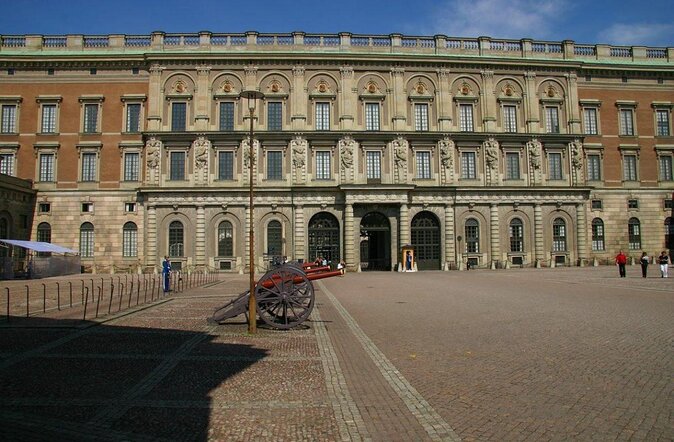
The Royal Palace is one of Europe’s largest royal residences and the official workplace of Sweden’s king and queen. The monarchy uses the building for official representation, so it is not merely a decorative leftover from another age.
The stop lasts about 10 minutes and is primarily an exterior viewing point. The tour does not include admission to the palace, so plan a separate visit if you want to see its rooms and collections.
I find this a useful distinction. You get the palace’s role in present-day Sweden without spending a large part of a short introductory tour indoors. The guide can also place the building within the surrounding Old Town, which makes the royal complex feel connected to the city rather than isolated from it.
If royal interiors are high on your list, treat this stop as an orientation rather than a full palace visit. The tour gives you the address, setting, and basic story, then keeps moving.
A completely different kind of day out around Stockholm:
- Stockholm: Highlights Boat Tour
★ 4.3 · 2,542 reviews - Stockholm Pass: Save up to 50% – Includes Vasa Museum Ticket
★ 4.1 · 2,392 reviews - Stockholm: Ghost Walk and Historical Tour
★ 4.7 · 2,206 reviews - Walking Tour of Stockholm Old Town
★ 5.0 · 1,175 reviews
Storkyrkan and Stockholm’s royal weddings
Storkyrkan, also called Stockholm Cathedral, is one of the city’s oldest buildings. It is known as the Coronation Church and has hosted important royal ceremonies, including the wedding of King Carl XVI Gustaf and Queen Silvia. Crown Princess Victoria and Prince Daniel were married there in 2010.
The tour description also points to the statue of St. George and the Dragon inside the brick Gothic church. The original sculpture is wooden, while the version outside is a bronze copy.
The church stop lasts about 10 minutes. Admission to Storkyrkan is not listed as included, so the focus may be on the exterior and on the church’s place in the city’s story. If the doors are open, your guide may provide more context, but you should not book this tour expecting a long church visit.
Still, this is one of the better history stops because it links architecture, religion, and the Swedish royal family in one place. The guide’s explanation helps you understand why this modest-looking part of Gamla Stan has carried so much national importance.
Järnpojke, Stockholm’s tiny statue

One of the tour’s more unusual stops is Järnpojke, the Iron Boy, also called the Boy Looking at the Moon. It is described as Sweden’s smallest statue and is known for its gentle, endearing appearance.
This is a welcome change from grand palaces and churches. Small public art often becomes memorable because it feels personal and easy to miss. The visit lasts about 10 minutes, giving you time to locate the statue and hear why it has become a favorite detail in Gamla Stan.
Do not expect a major attraction that fills an afternoon. The appeal is the contrast. Stockholm’s Old Town is not only about national ceremonies and medieval buildings. It also rewards people who notice the small things tucked into its lanes.
St. George, the dragon, and a medieval political story

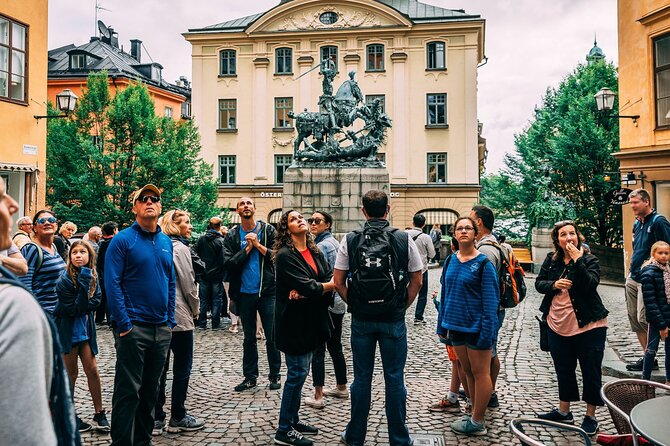
The St. George and the Dragon sculpture represents the struggle between Sweden and Denmark in the late 1400s. The copy outside Storkyrkan is bronze, while the original wooden sculpture is inside the cathedral.
The story gives the artwork a political edge. St. George is not just a saint defeating a monster here. He represents Sweden, while the dragon represents Denmark, turning a familiar religious image into a symbol of national conflict.
You spend around 10 minutes at this stop. The guide’s explanation is the useful part, since the sculpture can otherwise look like a decorative church feature. It is also a good example of how the tour adds meaning to sights that you could photograph in seconds.
Squeezing through Mårten Trotzigs gränd
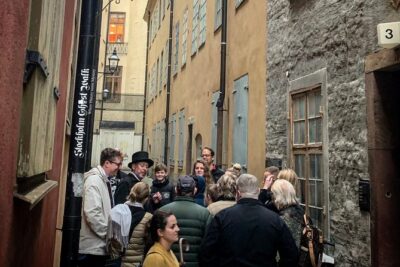
Mårten Trotzigs gränd is the narrowest alley in Stockholm, measuring only about 90 centimeters at its tightest point. You walk through a space built for an older city, not for cars, buses, or large crowds.
Some guidebooks call it the narrowest alley in Europe, but that claim is not accurate. A lane in Prague is only about 60 centimeters wide, and other European cities may have narrower passages as well. The guide’s willingness to correct the popular claim is a small sign of the practical, grounded tone you want from a city tour.
This stop is short, but it gives you a physical sense of medieval Stockholm. You are not only hearing that the streets are old. You are feeling how narrow and awkward they can be.
The alley also reinforces the tour’s main limitation. Gamla Stan is best enjoyed slowly, but this excursion uses it as a compact introduction. If you want time to browse shops, linger in courtyards, or explore side streets, return later on your own.
The public ferry from Skeppsbron to Djurgården
At Skeppsbron 26, the group boards a public ferry for the ride to Djurgården. The ferry ticket is included, and the trip takes about 20 minutes.
This is one of the tour’s strongest features. You get a practical form of public transport and a scenic break from walking at the same time. Stockholm is built around water, so crossing by ferry helps you understand the city’s shape better than moving only through streets.
Bring your camera, but do not expect a private cruise or a narrated boat excursion. This is regular public transportation. Its value comes from the route, the views, and the simple pleasure of crossing the harbor as part of your morning.
The ferry also gives your feet a short rest before the museum. That matters because the walking portion includes cobbles, narrow lanes, and frequent stops. If you have trouble walking, mention it to the guide at the start. One especially positive account described Katrine taking care with a participant who used a cane, but the tour still requires moderate physical fitness.
The Vasa Museum and the ship that sank on its first voyage
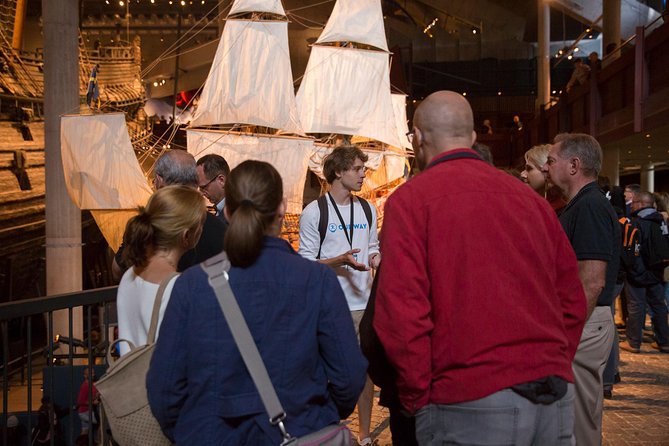
The tour ends with the Vasa Museum, where the group spends about one hour. Admission is included, and the guide leads you inside to explain the ship’s story.
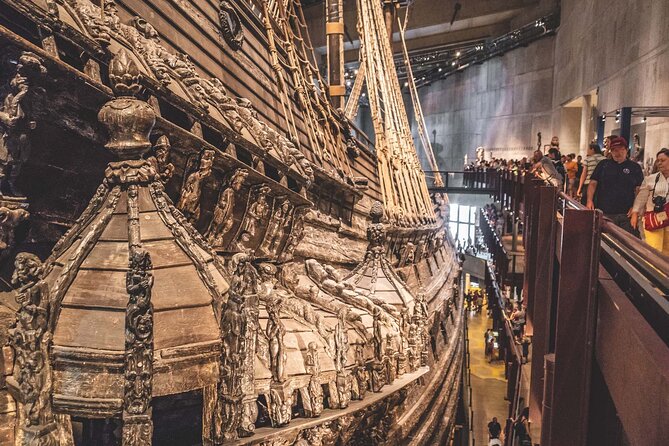
The Vasa was Sweden’s most expensive and richly decorated naval vessel in the 1600s. On its maiden voyage in 1628, people gathered along the Stockholm shore to wish it well. Instead, they watched it capsize and sink in the harbor.
Today, the ship is about 98 percent intact. That figure is what makes the museum so powerful. You are not looking at a modern replica or a few fragments behind glass. You are seeing a remarkably preserved seventeenth-century warship recovered and restored over many years.
The guide’s role is particularly useful here. The museum is large, and a first visit can feel like a lot to take in. A good explanation gives you a framework before you continue on your own. Several highly positive accounts singled out the Vasa as the most impressive part of the morning and said the introduction made it easier to explore the museum after the guided portion ended.
One hour is enough for a strong first look, but not enough for every exhibit. That is why the ending works well. The tour finishes inside the Vasa Museum, so you can stay longer if your schedule allows. Nearby museums include the ABBA Museum and the Armory, both of which were specifically recommended during the tour by guides.
Guide quality and group size
The guide can make or break this experience. The strongest feedback praised Kevin for being engaging, clear, and willing to answer questions. Ebba was praised for sharing personal insight into Swedish culture, while Katrine was noted for her clear speech, steady pace, and kindness toward a participant with limited mobility. Joel and Marita were also described as friendly, informative, and fun.
That pattern matters. This is not a silent transfer between attractions. Much of the value comes from hearing why a street has its name, how the royal buildings function, and what makes the Vasa unusual.
The advertised group size is a maximum of 16 people. A smaller group should make it easier to hear explanations and ask questions. One negative experience involved a larger group and a guide who spoke too quietly, making the walk frustrating. I would treat clear communication as an important quality check, especially on busy streets and during ferry boarding.
The overall rating is 4.7 from 231 reviews, with 92 percent recommending the experience. Those figures suggest a reliable outing, but they do not erase the need to match the tour to your expectations. The people who want a relaxed, detailed Old Town walk may find the schedule too tight. The people who want a useful overview tend to get more from it.
Price, pace, and who gets the best value
At $113.48 per person, this is not the cheapest way to walk through Gamla Stan. You are paying for a professional guide, the Vasa Museum entrance, and the public transport ticket, plus the convenience of linking two major sights without planning the route yourself.
I think the value is strongest for first-time visitors, short-stay visitors, and adults who want historical context rather than a simple list of photo stops. It is also a smart first-day activity. One particularly useful benefit is that the guide can point out places to revisit for food, museums, and further exploration.
The price is less appealing if you already know Stockholm well or prefer to explore at your own speed. You can walk Gamla Stan independently, and the Vasa Museum can be visited without this tour. The tour earns its cost through interpretation and time saved, not through exclusivity.
Wear shoes with good grip and cushioning. Dress for changing weather because the tour operates in all conditions. Most of the morning is outdoors, and the cobbles can be tiring even when the weather is pleasant.
You can cancel for a full refund up to 24 hours before the start time. The experience needs a minimum number of participants, so a cancellation by the operator may result in another date or a full refund.
Should you book Stockholm Must Sees?
Book it if you want a well-organized first look at Stockholm and prefer having a local guide connect the Old Town’s small details with the country’s larger story. The ferry crossing and included Vasa admission make the route more varied than a standard walking tour.
Skip it if you want long, unhurried visits inside the Royal Palace or Storkyrkan, or if you dislike walking on cobbles. The Old Town section moves quickly, and the Vasa Museum deserves more than one hour if you have a serious interest in maritime history.
For most first-time visitors, I would book this near the start of a Stockholm stay, then return to the places that caught your attention. It gives you the city’s basic framework, the Vasa’s unforgettable ship, and a practical idea of what to explore next.
FAQ
How long does the Stockholm Must Sees tour last?
The tour lasts approximately three hours.
What time does the tour begin?
It begins at 10:00 am.
Where does the tour start?
The meeting point is Stortorget 2 in Stockholm’s Gamla Stan.
Where does the tour finish?
The tour ends at the Vasa Museum on Galärvarvsvägen 14, Djurgården.
Is Vasa Museum admission included?
Yes. The Vasa Museum entrance fee is included in the tour price.
Is the ferry ticket included?
Yes. A public transport ticket for the ferry ride to the Vasa Museum is included.
How large is the tour group?
The tour has a maximum of 16 participants.
Can I cancel for a full refund?
Yes, if you cancel at least 24 hours before the experience start time. Changes or cancellations made less than 24 hours ahead are not accepted for a refund.
Recently added around Stockholm
- ROYAL Castle Skokloster and Viking Sigtuna (private tour)★ 4.5 · 3 reviews
- Stockholm Ghost Hunt: Self-Guided Tour and Puzzle Adventure★ 4.5 · 3 reviews
- Stockholm Port to Stockholm Arlanda Airport (ARN) – Departure Private Transfer★ 3.5 · 3 reviews
- Private Photography workshop in Stockholm★ 5.0 · 3 reviews
- Ghosts of Stockholm: A Guided Tour of Horror and Dark Folklore★ 4.5 · 3 reviews
- Private blood, ghosts and folklore Old Town 2h Stockholm tour★ 4.0 · 3 reviews
- Stockholm- Private transfer to/from Arlanda Airport and city★ 5.0 · 3 reviews
- Stockholm Arlanda airport to City center of Stockholm★ 3.3 · 3 reviews
Stockholm Tours, compared.

City Archipelago Sightseeing Cruise with Guide
Read our review →


The Original Stockholm Ghost Walk and Historical Tour – Gamla Stan
Read our review →
Browse the lists this tour appears in